

The Number That Changes Things
The EPA action level for radon is 4 picocuries per liter of air. That number means nothing until you know that Connecticut has significant radon risk zones - particularly in Hartford County, Tolland County, and areas along the Connecticut River Valley geology. The state's bedrock composition, including granite and uranium-bearing rock formations, releases radon naturally. It seeps up through foundations, through cracks in concrete slabs, through sump pits, through any gap between the ground and your living space.
Radon is colorless, odorless, and the second-leading cause of lung cancer in the United States after smoking. The only way to know your level is to test. You cannot detect radon any other way.
The good news - and this part matters - radon problems are fixable. A mitigation system works reliably and well. The issue isn't the radon itself. The issue is finding out you have it before you own the house, not after.
Testing: Short-Term vs Long-Term, DIY vs Professional
There are two categories of radon tests: short-term (48-96 hours) and long-term (90 days or more). Short-term tests are what you typically see in real estate transactions because they fit inside inspection periods. Long-term tests give a more accurate picture of average exposure but aren't practical for most purchase timelines.
For a home purchase in Connecticut, a short-term professional radon test placed in the lowest livable area of the home - usually the basement - is standard. The test kit sits for the required period, gets sent to a lab, and results come back within a few days. Some inspectors include radon testing as part of a full inspection. Others refer out to a separate radon testing company.
DIY test kits exist and are inexpensive. They work. For a real estate transaction, though, a professional test creates documentation that both parties can rely on and that the seller can't dispute as easily.
What the Numbers Mean and When to Act
EPA guidance is to take action when radon tests above 4 pCi/L. Below 2 pCi/L is considered low risk - the national average inside homes is about 1.3 pCi/L. Between 2 and 4 is a gray zone where mitigation is optional but reasonable. Above 4, the EPA recommends mitigation. Above 8, it recommends acting quickly.
A number between 4 and 6 in a Connecticut basement is common. It is not an emergency, and it is not a reason to walk away from a house you want to buy. It is a reason to either ask the seller to install a mitigation system before closing, negotiate a credit to cover the cost, or understand that you'll handle it after closing.
Where buyers make mistakes is treating any radon result as a deal-killer. That's an overcorrection. A result of 5 pCi/L in a house you otherwise love is a problem you can fix for a known cost. A result of 15 pCi/L in a house with no basement and limited mitigation options is a different conversation.
How Radon Mitigation Actually Works
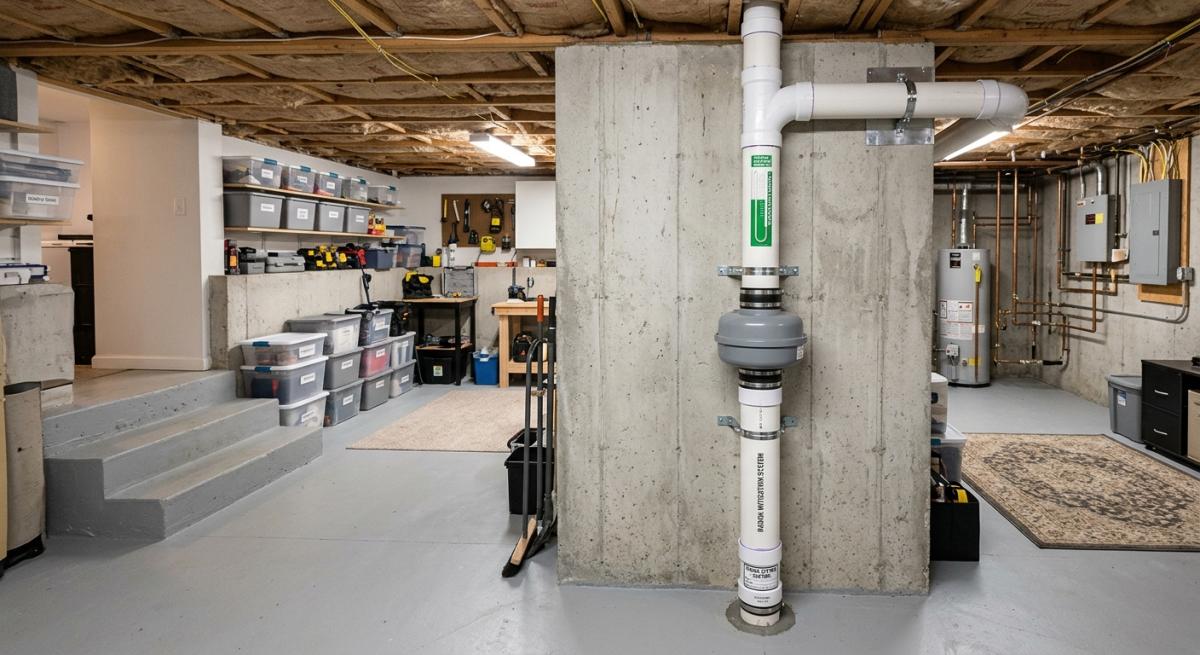
The standard fix is called sub-slab depressurization. A licensed radon mitigator drills one or more holes through the basement floor or foundation slab, installs a PVC pipe, and connects it to a continuously running fan that draws radon from under the foundation and exhausts it outside above the roofline. The system runs constantly and quietly. Most homeowners stop thinking about it within a week of installation.
Mitigation systems are permanent, effective, and well-understood. They bring nearly every home below the 2 pCi/L level when properly installed. Connecticut has licensed radon mitigators - look for contractors certified through the National Radon Proficiency Program or the National Radon Safety Board.
Post-mitigation testing confirms the system is working. That's a short-term test run after installation, typically 24-48 hours after the system is up and running.
Basically, radon mitigation is one of the most straightforward home health problems to solve. The system works. It has a track record. The cost is real but fixed and knowable before you close.
How It Affects Your CT Real Estate Transaction
For buyers: include a radon test as part of your inspection contingency. In Connecticut, this is standard practice. If the test comes back above 4 pCi/L, you have options - request a seller credit, require installation before closing, or factor the cost into your offer revision. Don't skip the test to keep your offer looking cleaner. The risk-adjusted cost of skipping is much higher than the inconvenience of including it.
For sellers: if you've never tested your home, test it before you list. If the result is elevated and you get out ahead of it - install the system before you put the house on market - you remove a negotiating issue entirely. A home with a radon system already installed and a post-mitigation test showing clean results is a stronger listing than one that tests high during the buyer's inspection period.
One more thing sellers often don't realize: a radon system is actually a selling point. Buyers who see a professionally installed, operating system and a clean post-mitigation test know the problem was identified and solved correctly. That's better than a house that was never tested and leaves the question open.
Frequently Asked Questions
Is radon common in Connecticut homes?
Yes. Connecticut has significant geological radon risk, particularly in Hartford County, Tolland County, and areas with granite bedrock. The EPA estimates roughly 1 in 15 American homes exceeds the 4 pCi/L action level nationally; in higher-risk states like Connecticut the share is meaningfully higher in certain areas. The only way to know your home's level is to test — there's no way to detect radon without a test.
Does Connecticut require radon disclosure in home sales?
Connecticut does not have a statewide law requiring radon testing or disclosure as a condition of sale. However, the CT Residential Property Condition Disclosure Report asks sellers to disclose known radon issues. A seller who is aware of elevated radon and does not disclose it may have legal exposure. Many buyers in CT now include radon testing as a standard part of the inspection contingency.
How much does radon mitigation cost in Connecticut?
Radon mitigation system costs in Connecticut typically range from around $800 to $2,500, depending on the home's foundation type, size, and how many suction points are needed. Most single-family homes with a poured concrete basement require one suction point and fall toward the lower end of that range. Get quotes from at least two licensed Connecticut radon mitigators before committing.
Can I still buy a Connecticut home with elevated radon?
Absolutely. Elevated radon is a common finding in Connecticut real estate transactions and rarely ends deals. The standard approach is to negotiate with the seller — either a price reduction to cover mitigation, a seller credit at closing, or requiring the seller to install a system before closing. Once mitigated, the home is no different from one that never had a radon issue.