

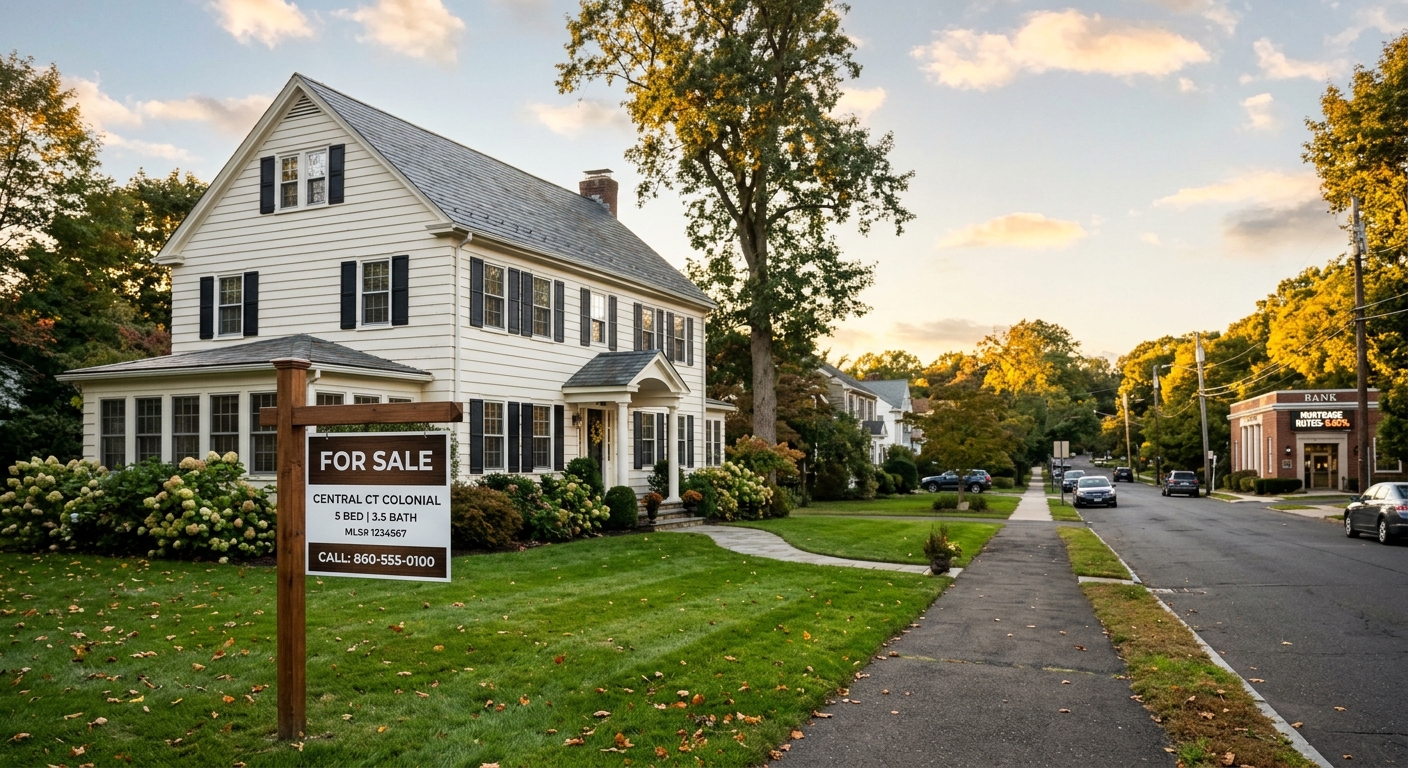
Sellers Aren't Cutting Price Anymore - They're Buying Down the Rate
Here's a number that should catch your attention if you're thinking about listing: sellers gave buyers some kind of concession in more than 45% of U.S. home sales this September, the highest share for that month going back to at least 2020. That's not a small shift. That's almost half the market.
And the concession of choice right now isn't a price cut. It's a rate buydown. Sellers are paying points to knock the buyer's mortgage rate down instead of knocking dollars off the sale price. I've started walking sellers through this exact comparison, and once you see the math, it's not even close in a lot of cases.
Let me put it this way: a price cut hurts you dollar for dollar. A buydown can cost you less and still get the buyer a bigger monthly payment reduction. That's the trade sellers in Southington, Berlin, and Newington should be thinking about right now, not whether to drop their list price another $10,000 and hope.
The Basic Math on a Point
One discount point typically costs 1% of the loan amount and buys the buyer about 0.25% off their interest rate. So on a $400,000 loan, one point runs around $4,000 and gets the rate down roughly a quarter point. Two points, roughly $8,000, gets you closer to half a point off.
With the 30-year fixed averaging 7.32% as of late October, according to Freddie Mac, a buydown that gets a buyer from 7.32% down to something in the high 6s is a real monthly savings. That's the kind of thing that gets a buyer off the fence.
Basically, the seller is paying to make the buyer's monthly payment smaller instead of making the house cheaper on paper. Those are two very different moves. They hit the seller's wallet differently.
A Worked Example at a Realistic Central CT Price
Say you're selling a home in Southington at a price point around $450,000, which lines up with where our local comps have been running. Let's compare two scenarios for the exact same buyer.
- Scenario A - Price cut: You drop the price from $450,000 to $437,000. That's a $13,000 reduction straight off your net proceeds, on top of everything else you're already paying at closing.
- Scenario B - Rate buydown: You keep the price at $450,000 and offer to pay roughly $9,000-$10,000 toward points, buying the buyer's rate down close to half a point.
In Scenario A, the buyer's monthly payment barely moves because price reductions on a mortgage payment are diluted - a $13,000 price drop might only save a buyer somewhere around $70-$80 a month. In Scenario B, that same buyer could see their monthly payment drop more meaningfully, for less money out of your pocket.
The buyer still has to agree the price is fair relative to the comps. This only works when the home is priced correctly to begin with. If the house is overpriced by $20,000, a buydown doesn't fix that - it just makes an overpriced house slightly more affordable monthly, which is still chasing the market. I've seen sellers lean on a buydown to avoid admitting the list price was wrong from the start. It never works. The buydown gets evaluated against the comps just like the price does, and buyers doing their homework will catch it either way.
Concession Caps Are Different by Loan Type - This Trips People Up
Here's where it gets complicated, and it's something a lot of sellers don't realize until their agent brings it up. How much a seller can actually contribute toward a buydown depends on the buyer's loan type and down payment size.
| Loan Type | Typical Seller Concession Cap | Notes |
|---|---|---|
| Conventional, less than 10% down | 3% of purchase price | Most first-time buyers fall here |
| Conventional, 10-25% down | 6% of purchase price | Bigger down payment buys more room |
| Conventional, 25%+ down | 9% of purchase price | Rare for first-timers, more common with move-up buyers |
| FHA | 6% of purchase price | Different rules than conventional, often more flexible |
| VA | 4% of purchase price (plus closing costs separately) | Structured differently - talk to the lender directly |
So, before you and your agent even start the conversation about how much to offer, you need to know what the buyer's loan allows. A seller offering $12,000 toward a buydown on a conventional loan with 5% down and a buyer who's already near their 3% cap for other closing costs - that doesn't work. The lender will cap it regardless of what you're willing to pay.
Why This Protects Your Net Proceeds Better Than It Looks
Sellers get nervous about writing a check at closing. It feels like giving money away. But when you run the actual numbers against a price cut, a buydown usually protects more of your net proceeds for the same amount of buyer benefit.
Remember, on a Connecticut sale, you're already paying conveyance tax - 0.75% on the first $800,000 of the sale price, plus a local portion, typically 0.25% in most towns. On a $450,000 sale, that's $4,500 in conveyance tax alone, plus attorney fees in the $700-$1,500 range, since Connecticut requires an attorney at every closing. A price cut doesn't just cost you the reduction itself. It's a lower number that your conveyance tax and other proportional costs are calculated against going forward if you have to keep dropping.
A buydown is a fixed cost you negotiate once. A price cut, especially if it starts a pattern, turns into chasing the market - list high, sit, drop, sit again, drop again. That's a red flag for buyers watching your days on market tick up. A buydown offered upfront, especially paired with a correctly priced home, signals confidence instead of desperation. Confidence sells houses.
What Buyers Should Actually Ask For
If you're on the buying side in Southington or Berlin right now, don't assume the seller will bring this up first. Ask about it. Structure your offer to request a seller credit toward a rate buydown instead of (or in addition to) a price reduction.
But here's the thing most buyers don't realize - a temporary buydown, where the rate is reduced for the first year or two and then steps back up to the note rate, can be even more powerful than a permanent one if you expect your income to grow or you plan to refinance down the road anyway. It gets you breathing room exactly when you need it most. That's usually right after you've taken on moving costs, new furniture, and all the stuff nobody budgets for.
The break-even horizon matters here. If you're paying for points yourself, or the seller credit is being traded against a bigger price concession, do the math on how many months of lower payments it takes to
Frequently Asked Questions
Is a rate buydown better than a price cut for a CT seller?
Often yes, because a buydown delivers a bigger monthly payment benefit to the buyer per dollar spent than a price cut does. It also avoids the appearance of a struggling listing, which can happen when sellers drop price repeatedly.
How much does a mortgage point cost and what does it save?
One point typically costs 1% of the loan amount and lowers the rate by about 0.25 percentage points, though the exact reduction varies by lender. On a $400,000 loan, that's roughly $4,000 for a quarter-point rate reduction.
Are seller concessions capped in Connecticut?
Caps come from the loan type, not the state. Conventional loans with under 10% down are typically capped around 3% of the purchase price, while FHA allows up to 6% and VA loans have their own separate structure.
Do rate buydowns affect my CT closing costs as a seller?
The buydown cost is separate from closing costs like conveyance tax and attorney fees, which still apply regardless of whether you offer a buydown or a price cut. On a $450,000 sale, conveyance tax alone runs about $4,500.
Should I ask my agent about a buydown before listing?
Yes. Talk through both scenarios, price cut versus buydown, with real numbers before you list, not after the home sits for a few weeks. Pricing it right from day one still matters more than either concession.